

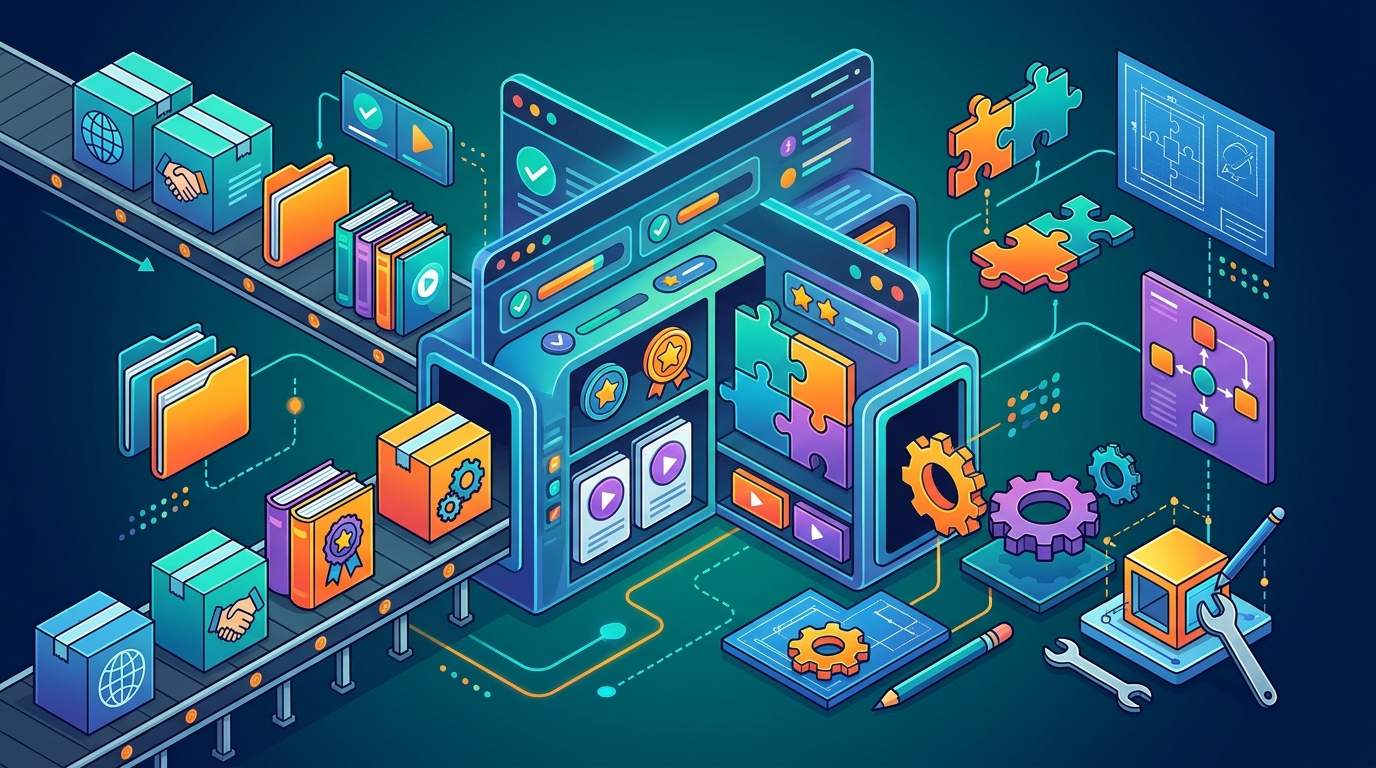
Companies mix off-the-shelf and custom training in one Learning Management System (LMS) to balance speed with relevance. Ready-made courses provide immediate access to expert-led content, while custom modules capture unique internal processes. This hybrid approach ensures employees learn both industry standards and company-specific workflows without switching platforms.
The Efficiency of Ready-Made Content
Off-the-shelf courses are pre-built training modules created by external experts. They allow organizations to launch training programs immediately without the time and cost of authoring from scratch. For general business skills, such as communication or basic software proficiency, these courses are often sufficient and highly cost-effective.
GoSkills, for example, offers a library of over 500 expert-led courses covering topics from Microsoft Excel to leadership. This ready-made content allows teams to start upskilling on day one. The primary benefit is speed. Instead of spending months developing a generic leadership course, a manager can assign an existing, high-quality module to their team. This accelerates the time-to-value for the training investment.
The Necessity of Custom Internal Training
Custom training is content created specifically for an organization's unique processes, products, or culture. While off-the-shelf courses cover broad skills, they cannot teach an employee how to use a proprietary software tool or follow a specific internal compliance protocol. Custom content bridges this gap by translating tribal knowledge into structured, repeatable lessons.
Consider a company with a unique sales methodology. A generic sales course might teach negotiation tactics, but it will not teach the specific steps of that company's CRM workflow. By creating custom modules, the organization ensures that every employee follows the same standardized process. This reduces errors and improves consistency across teams. It also allows the company to protect its intellectual property by keeping specific methodologies internal.
Unified Tracking and Reporting
Using a single LMS for both content types is critical for accurate performance tracking. When training is scattered across multiple platforms, administrators struggle to get a holistic view of employee progress. A unified system consolidates all learning data into one dashboard, making it easier to identify skill gaps and measure ROI.
In a single platform, an administrator can see that an employee completed a generic Excel course but failed a custom module on the company's specific data reporting standards. This granular visibility allows for targeted interventions. It also simplifies compliance reporting, as all required training, whether generic or specific, is recorded in one place. This reduces administrative overhead and ensures that no training falls through the cracks.
Reducing Cognitive Load for Learners
Learner experience is a key driver of training completion rates. When employees are forced to log into multiple systems to complete their training, it creates friction and cognitive load. A single, intuitive interface for all learning activities improves engagement and reduces the likelihood of abandonment.
GoSkills emphasizes a user-friendly experience with its integrated LMS and Learning Experience Platform (LXP). By combining ready-made and custom content in one place, the platform presents a unified catalog to the learner. This seamless experience encourages employees to engage with both types of content. It also allows for personalized learning paths that blend general skills with specific role requirements, creating a more coherent learning journey.
Scalability and Future-Proofing
A hybrid content strategy allows organizations to scale their training programs as they grow. As new products or processes are introduced, custom content can be added to the existing library without disrupting the overall structure. This flexibility ensures that the training program evolves alongside the business.
Furthermore, maintaining a single LMS simplifies vendor management and integration. It reduces the need for multiple API connections and data syncs. This technical simplicity makes it easier to adopt new technologies or update existing ones. It also ensures that the organization is not locked into a single content provider, allowing for greater flexibility in the long term.
Key Takeaways
- Off-the-shelf courses provide immediate access to expert-led content for general skills.
- Custom training captures unique internal processes and proprietary knowledge.
- A single LMS unifies tracking, reporting, and compliance for all training types.
- Consolidating content in one platform reduces cognitive load and improves learner engagement.
- A hybrid strategy allows for scalable and future-proof training programs.
- GoSkills supports this model by integrating a large course library with a powerful course builder.
Frequently Asked Questions
What is the main advantage of using one LMS for all training?
The main advantage is unified data and reporting. A single platform allows administrators to track progress, completion rates, and performance metrics for both off-the-shelf and custom courses in one dashboard. This provides a complete view of employee development and simplifies compliance management.
Can I use custom content alongside third-party courses in GoSkills?
Yes, GoSkills allows organizations to use its built-in course library alongside custom content created with its course builder. The platform integrates both types of content into a single training library, enabling seamless assignment and tracking.
How do I decide which topics need custom training?
Topics that involve proprietary processes, specific software tools, or unique company policies require custom training. General skills, such as communication or basic software proficiency, are often better served by off-the-shelf courses. Assess your internal needs to determine where custom content adds the most value.
Does mixing content types complicate the LMS setup?
Not if the LMS is designed to support both. Modern platforms like GoSkills are built to handle mixed content libraries. They provide tools for importing, creating, and managing both types of content within the same interface, ensuring a smooth setup process.
Is it more expensive to maintain custom content?
Custom content requires initial investment in creation and ongoing maintenance to keep it up to date. However, it often provides a higher return on investment by directly addressing specific business needs. Off-the-shelf courses are generally cheaper upfront but may not address unique internal requirements.
Conclusion
Mixing off-the-shelf and custom training in a single LMS is a strategic move that balances efficiency with relevance. It allows companies to leverage expert content for general skills while preserving the integrity of their unique processes. GoSkills provides the infrastructure to support this hybrid model, offering a robust library of ready-made courses and a flexible course builder for custom content. To see how this works in practice, book a demo with the GoSkills team.