

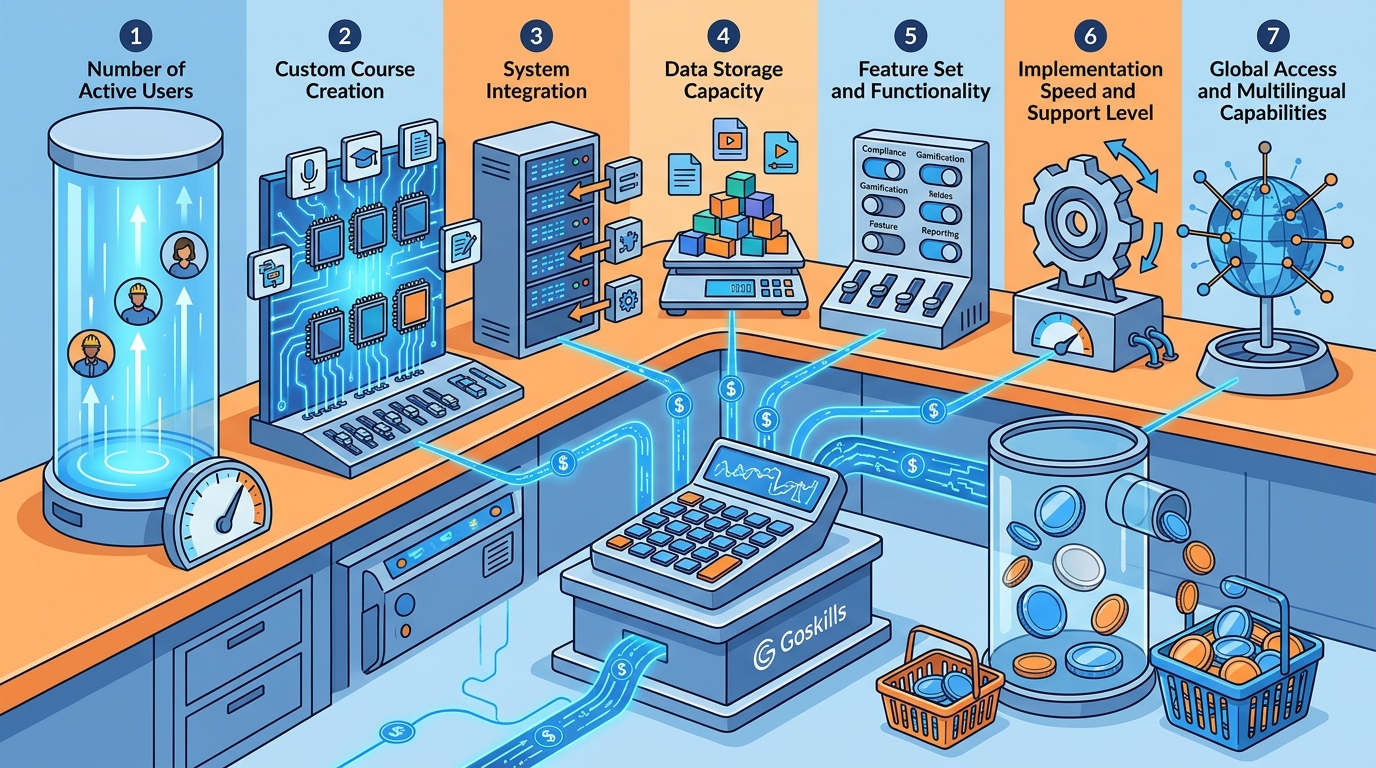
Choosing training software for a small or medium-sized business often feels like a guessing game. Prices can range from a few hundred dollars to several thousand per year, leaving many owners confused about what they are actually paying for. Understanding the specific drivers behind these price tags helps you avoid overpaying for features you do not need. This guide breaks down the seven key variables that influence the final cost of your learning management system (LMS).
1. User Licensing Model
The number of active learners directly dictates your monthly or annual bill. Most platforms charge on a per-user basis, meaning the cost scales linearly with your headcount. Some vendors charge for every registered user, while others only bill for active users who log in during a specific period. This distinction is critical for seasonal businesses or teams with fluctuating staffing levels.
2. Content Library Inclusion
Access to pre-built course catalogs is a major cost differentiator. Some LMS platforms are empty shells that require you to create all content from scratch, which is cheaper upfront but expensive in terms of time. Others include a library of hundreds of professional courses in their base price. If you need ready-made training in areas like Excel or leadership, expect to pay a premium for the content included in the subscription.
3. AI and Automation Features
Advanced artificial intelligence tools often sit in higher pricing tiers. Features like AI-powered course creation, automated learner nudges, and personalized learning paths require significant development investment. While basic tracking is standard in most plans, sophisticated automation that reduces administrative workload is frequently reserved for mid-tier or enterprise plans. Evaluate whether your team has the bandwidth to manage training manually or if you need these tools to save time.
4. Integration Capabilities
The depth of third-party integrations can significantly impact pricing. Connecting your LMS to HRIS, CRM, or payroll systems ensures data flows seamlessly across your tech stack. Basic integrations are often free, but deep, bi-directional syncs or API access may require a higher-tier plan. If your operations rely heavily on specific software, verify that the LMS supports those connections without incurring extra fees.
5. Support and Onboarding Services
The level of human support provided by the vendor affects the total cost of ownership. Entry-level plans typically offer community forums or email support with slower response times. Higher-tier plans often include dedicated account managers, live onboarding sessions, and priority phone support. For small teams without dedicated IT or L&D staff, paying for white-glove onboarding can be a worthwhile investment to ensure a smooth launch.
6. Security and Compliance Requirements
Advanced security certifications and compliance features drive up infrastructure costs. If your industry is regulated, you may need specific data residency options, SOC 2 compliance, or GDPR-ready data handling. These features ensure your employee data is protected and auditable. While most modern platforms offer basic security, enterprise-grade compliance features are often gated behind higher price points.
7. Contract Length and Billing Frequency
Committing to annual or multi-year contracts usually lowers the per-user cost. Most vendors offer discounts for annual billing compared to monthly plans. Some also provide volume discounts for larger teams. Conversely, month-to-month contracts offer flexibility but come at a premium. Calculate the total cost of ownership over 12 to 36 months to see which billing structure offers the best value for your budget.
Choosing the Right Fit
Frequently Asked Questions
What is the average cost of an LMS for a small business?
Do free LMS plans have hidden costs?
Is it worth paying for a course library?
If you lack the time or expertise to create high-quality training content, a built-in library is often worth the premium. It provides immediate value and ensures professional standards without the overhead of instructional design.
How do I avoid overpaying for features I do not use?
Can I switch LMS providers if I outgrow my current plan?
Yes, but data migration can be complex. Before committing, ensure the platform allows you to export your learner data and course content in standard formats. This protects your investment if you decide to switch providers in the future.